

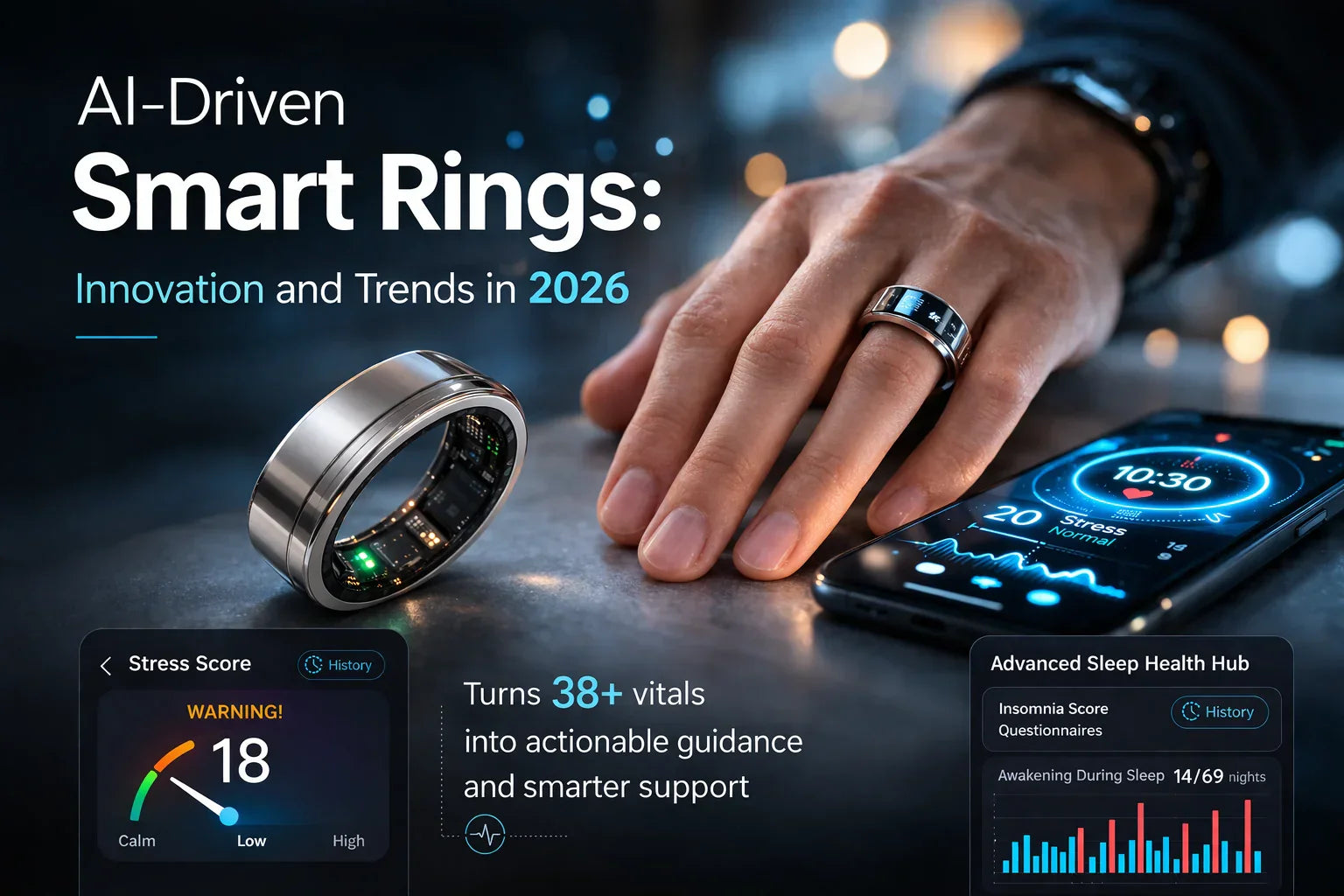
In recent years, wearable technology has evolved significantly. Earlier, many people relied on fitness bands and smartwatches to monitor their health and daily activities. With continuous innovation in the tech industry, newer and more advanced wearable devices have entered the market.
In 2026, smart rings are emerging as a modern addition to wearable technology. These devices feature a compact and elegant design while offering advanced health-tracking capabilities. More than just a stylish accessory, smart rings are designed to monitor key health metrics, making them a valuable option for individuals focused on maintaining an active, healthy lifestyle.
1- What is AI Ring?
An AI Ring is a smart wearable device that uses artificial intelligence to monitor health and daily activity. It provides real-time health insights powered by AI, tracking key metrics such as HRV (98% accuracy), pulse rate (99% accuracy), body temperature, step count, sleep patterns, stress trends, blood oxygen saturation (SpO₂), and respiratory rate. Connected to a smartphone app, an AI ring analyzes this data to deliver personalized health insights and wellness recommendations.
2- How Do Smart Rings Integrate with Artificial Intelligence?
These sensors gather various types of health and activity data from the user.
-
Heart rate monitoring
-
Blood oxygen level measurement
-
Skin temperature tracking
-
Sleep pattern analysis
-
Stress level detection
- Daily activity tracking
However, collecting data is just the first step. The real role is played by artificial intelligence.
AI systems analyze this raw data and convert it into meaningful insights. Instead of only showing numbers, the system studies patterns. For example, if your heart rate increases, the AI can determine whether it’s because of exercise, stress, or lack of sleep. It doesn’t just track how long you slept; it checks the quality of sleep and predicts how well your body has recovered.
Smart rings use:
-
On-device machine learning for instant feedback
-
Cloud-based AI for deeper analysis
-
Predictive models to detect possible health risks
-
Adaptive systems that improve over time
The more you wear the ring, the more accurate and personalized it becomes. Over time, it understands your normal patterns and can quickly detect anything unusual.
3- What Problem Does an AI Smart Ring Solve?
AI smart rings are not just smaller fitness trackers. They solve some common problems that users face with other wearable devices.
1. Too Many Notifications - Smartwatches constantly send alerts, which can feel distracting. Smart rings use gentle vibrations instead of screens, reducing digital overload.
2. Comfort Issues - Watches can feel bulky, especially during sleep. Rings are lightweight and comfortable enough to wear all day and night.
3. Continuous Monitoring - Since rings are worn on fingers where blood vessels are closer to the skin, they can sometimes provide more consistent readings compared to wrist devices.
4. Less Screen Dependency - Smart rings depend on companion mobile apps. This means you check insights only when needed, rather than staring at a screen all day.
5. Better Privacy Focus - Many smart rings now use secure encryption and on-device processing to protect personal health data.
In short, AI smart rings make technology calmer, less intrusive, and more intelligent.
4- AI Smart Ring vs Smartwatches: What Is the Difference?
Both smart rings and smartwatches come under wearable technology, but their purpose is slightly different.
Smartwatches are interactive devices. They allow calling, messaging, app usage, and full-screen notifications. They are almost like small smartphones on your wrist.
Smart rings, on the other hand, focus more on silent tracking and background monitoring. They don’t try to replace your phone. Instead, they quietly collect and analyze data.
Here are some key differences:
-
Design: Rings look like jewelry; watches look like gadgets.
-
Notifications: Rings use subtle vibrations; watches show full-screen alerts.
-
Battery Life: Rings often last longer due to no large display.
-
Comfort: Rings are more comfortable during sleep.
-
Usage Style: Rings are passive; watches are interactive.
You can say smartwatches are digital assistants, while smart rings are silent health companions.
Also Read This - How to Use an ECG Smart Ring for Health Monitoring
5- The Evolution of Smart Rings in 2026
A few years ago, smart rings were considered niche products. Early versions mainly tracked steps and basic sleep data.
But in 2026, their capabilities have expanded significantly.
Modern AI smart rings can now offer:
-
Stress detection through heart rate variation
-
Fertility and hormonal cycle tracking
-
Contactless payments
-
Secure digital authentication
-
Gesture control for smart home devices
-
Early illness detection through temperature changes
One major improvement is real-time adaptation. For example, if the ring detects high stress levels for multiple days, it may suggest breathing exercises or lifestyle adjustments.
Smart rings are no longer just trackers. They are becoming personal wellness guides.
6- Technology Trends and Market Size of Smart Rings
The smart ring market is growing rapidly. Experts predict that by the end of 2026, the global market will reach several billion dollars. This growth is driven by:
-
Increased health awareness
-
Demand for minimal and stylish wearables
-
Growth of AI-based healthcare solutions
-
Expansion of IoT ecosystems
Some major technology trends include:
Miniaturization of Sensors
Advanced engineering has made it possible to fit powerful sensors into small ring designs.
AI Edge Computing
More data is processed directly on the device, improving speed, privacy, and battery efficiency.
Advanced Materials
Use of titanium, ceramic coatings, and waterproof technology improves durability and design.
Subscription-Based Insights
Some brands now offer premium AI insights and coaching through subscription services.
With growing interest in personalization and minimalism, smart rings are expected to grow faster than many other wearable devices.
7- What Are AI Models for Jewelry?
AI is not only used inside smart rings for health tracking, but it is also used in jewelry design and marketing.
AI models help in:
-
Creating new ring designs using generative algorithms
-
Suggesting personalized styles based on user preferences
-
Predicting fashion trends using machine learning
-
Forecasting product demand for retailers
These AI systems help brands design better products and manage inventory more efficiently.
In the smart ring industry, AI plays a dual role, powering the technology inside the ring and shaping how the product is created and sold.
8- How AI Models Enhance Product Visualization
Buying jewelry online has always been challenging. Customers often wonder how a ring will actually look on their finger.
AI is solving this problem through advanced visualization tools.
Virtual Try-On Technology
Using augmented reality, customers can see the ring on their finger in real time.
3D Customization
Buyers can change colors, finishes, sizes, and engravings while viewing realistic previews.
Personalized Suggestions
AI analyzes skin tone and style preferences to recommend suitable designs.
Lighting Simulation
Advanced rendering technology shows how the ring will look under different lighting conditions.
These features increase customer confidence and reduce product returns.
9- The Future of AI-Driven Smart Rings
As 2026 progresses, AI smart rings are becoming more than simple accessories. They are turning into health guardians, secure digital keys, and intelligent lifestyle partners.
Future developments may include:
-
Non-invasive glucose monitoring
-
Emotion detection
-
Digital identity integration
-
Improved battery technology
The combination of artificial intelligence, wearable hardware, and jewelry craftsmanship has created a unique product category, one that blends beauty with intelligence. In a world full of constant notifications and screen time, smart rings represent a quiet revolution. They work silently in the background, learning continuously and supporting users without overwhelming them. The era of invisible AI has truly begun, and it now fits comfortably on our fingers.
In conclusion, the emergence of AI-powered smart rings has ushered in a new era of innovation in wearable technology. These small gadgets (AI Ring), in contrast to conventional fitness bands or smartwatches, combine cutting-edge sensors with artificial intelligence to provide more in-depth health insights while remaining discrete and comfortable. AI rings are revolutionizing people's understanding of their health by tracking heart rate, sleep quality, stress levels, and offering predictive wellness recommendations. They are useful for daily use because of their intelligent data analysis, continuous monitoring capabilities, and simple design. AI smart rings are anticipated to be crucial to modern wearable innovation and personalized health management as technology develops in 2026 and beyond.
Click here- Top 10 Smart Ring Features and Advantages
Share:
How to Use ECG Smart Ring for Health Monitoring
How Are Smart Rings Powered? Technology, Features & Future of Smart Rings in 2026